






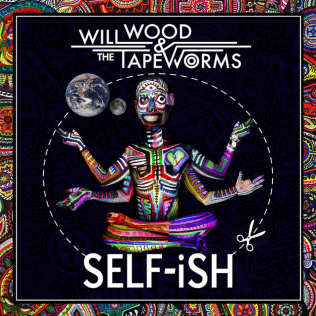















Self-ish is an album by Will Wood and The Tapeworms released in 2016. It was their second released and second most popular album to date. The name “Self-ish” is a play on words, referring both to being selfish but also to not feeling fully like yourself, coming from the suffix -ish, meaning somewhat. The album covers topics of self identity and what makes someone themselves. This is reflected through the name, feeling self-ish. The album has a total of eight songs which individually can all be interpreted differently, but can also come together to tell a larger story about self-discovery and acceptance.
“Self-”
“Self-” is the first song of the album and starts us off with a soft and melodic piano creating a more light hearted and soothing sound compared to the rest of the album. It is spoken from the perspective of our protagonist, who is never named. They talk about how they have lost something, their memories, and how the only ties to their past are their friends and family. But they aren’t content with this. These people see them as someone who was lost, along with their memories. This misidentification is compelling them to find the truth, so they decide to find out who they were. They set out on a journey, at the end of which they will hopefully be themselves again.
“2012”
“2012” serves as a better view of what the album is like, loud and chaotic. This song, however, is more of a “false start” with its whimsical sounds unlike the rest of the album. Our protagonist tells us how they lost themselves in 2012 and quite literally can’t remember the year. They tell us how they were constantly under one influence or another, whether it was alcohol, substances, or even religion. Their memories are so far gone and so distorted that they completely lost sight of who they were and who they became that year, having only what people tell them to go off of.
“Cotard’s Solution (Anatta, Dukkha, Anicca)”
The name “Cotard’s Solution” comes from Cotard’s syndrome, or walking corpse syndrome. This is a rare neuropsychiatric condition where a person fully believes in their mind that they are dead and a walking corpse. This song starts off very quiet before a pause in music followed by a roaring, disorderly sound the rest of the song. This could reflect their journey and how it’s really getting started; we were in the calm, but now we are in the storm. The song focuses on the fact that they want to change how people see them, but they also want to influence how the shift itself is seen. They feel like they are carrying the perception of a past self around like a corpse. They are trying to “kill” the version of themselves that other people see, leaving just their true self, making it seem as if they’ve gone on a journey to improve instead of suddenly waking up as a completely person. However, if they do this, they know that people will still see them as they were in 2012, and will thus have a bad image of them. They are stuck between being perceived as the “bad” version of themselves and being a new, better version. There is a line that is repeated towards the start and end of the song, “And if dreams can come true, what does that say about nightmares? I’ll stay awake tonight.” This could allude to how our protagonist is willing to stay put more than they are willing to take a risk, solely because it could lead to them being stuck in the “bad” version of themselves.
“Mr. Capgras Encounters a Secondhand Vanity: Tulpamancer’s Prosopagnosia/Pareidolia (As Direct Result of Trauma to the Fusiform Gyrus)”
This song’s name is the most complicated in the album, but I’ll do my best to break it down. Mr. Capgras most likely refers to Capgras syndrome, which is a condition where the affected person believes someone they know or are close with has been replaced by an imposter. A tulpamancer is more or less someone who creates an imaginary friend, that friend being an extension of themselves. Prosopagnosia is a condition that makes it hard for people to recognize faces, and Pareidolia is the human mind’s tendency to see faces in everyday items. Finally, the fusiform gyrus is the part of the brain that deals with recognizing faces and items. Essentially what the song title is saying is that our protagonist has Capgras syndrome and Prosopagnosia, due to some kind of head trauma, and because of their imaginary friend, they believe that they themselves are an imposter trying to replace themselves. Fittingly, the song starts with our protagonist repeating the phrase “you’re trying to replace yourself.” This, coupled with the information we got from the last song, gives us a look at the whole or at least more of the picture. Our protagonist believes themselves to be a walking corpse, a replacement of who they really are. But they want to change that, to change themselves and how they are perceived. They start questioning what makes them who they are. What sets them apart from the original if they have the same memories, feelings and actions? Are they even really a person, or are they destined to just be a clone, never their own individual?
“The Song with Five Names a.k.a. Soapbox Tao a.k.a. Checkmate Atheists! a.k.a. Neospace Government (A.K.A. You Can Never Know)”
This song expands on a question asked in the previous song, what makes you you, but it also begins questioning if doing all this “digging” into the past can have consequences. The song itself is very fast, both with the music and the lyrics, resembling an argument of sorts. The protagonist offers ideas for what could make them themselves, but it’s almost as if the other version of themselves keeps shooting down their ideas. Throughout the song, extra background vocals can be heard that don’t feature as prominently on the other tracks. These voices are almost taunting the protagonist, saying things like “you can never know,” and “gotta get to the bottom of this.” The voices are driving the protagonist forward, despite them themselves knowing that they should stop before they find something they don’t like. Then, they reach their limit, and begin to break.
“Hand Me My Shovel, I’m Going In!”
I believe that this song is the climax of the album and of the story, where our protagonist has finally broken through the unknown and is discovering what they had lost. The song starts off somewhat slow with a groovy vibe, but it quickly speeds up, getting louder and louder, as if we are watching our protagonist rapidly lose themselves. They try to explain what happened in 2012, how they fell in love and had their dreams crushed, but they don’t have the whole story. They have yet to find how their life spiraled out of control and why people remember them how they do, so they keep digging and digging and finding more and more unpleasant memories. There is still a part of them that knows they should stop, but a bigger part of themselves wants to finish what they started. They start spiralling, losing themself in the hole they dug, and then in an instant, they stop.
“Dr. Sunshine Is Dead”
This song is regarded as the climax for many people, but I believe it serves more as a falling action. “Hand Me My Shovel, I’m Going In!” serves better as a climax since it feels a lot more action packed and gives us an answer to the biggest question posed, what happened in 2012? This song starts with our protagonist questioning why they became afraid of the dark. The dark is a metaphor for the unknown, mentioned in a few other songs like “Cotard’s Solution” They thought that finding the unknown would change them and how others see them, but the only thing that has changed is how they see themselves. They believed that once they found their past, who they were would be as clear as day and night, but now they can’t tell who they are. It’s as if they were somewhere in between the two personas given to them. They realize that no matter what they do, people will see them in a negative light, as it is our past that shapes how others perceive us. They wish they had kept their past hidden, so they could have been anyone they wanted to be, but they know they can’t go back. They finally give into their past; if it doesn’t matter who they are, they might as well be bad.
“-Ish”
This song works to wrap up the album and is also a reprise of “Self-”. It starts a lot louder and faster then “Self-” did, showing how our protagonist has grown and changed through the album. They reflect on their life and the choices they’ve made. They think, “If I were to die right now would I be happy?” They wonder if they’ve truly changed, or if they just went on this journey to change how they view themselves. The music comes to a slow as their voice dies down. They have an epiphany that they are who they want to be, whether that’s a point in time and space, or the truths they tell themselves. They have all these possibilities of who they could be in the future, but right now, they just want to be.
Conclusion
Self-ish is a unique album and one of my favorites I’ve listened to. Each song is so lyrically strong that my analysis is one of many. The most prominent theme of the album is your identity. The whole album dissects what makes up one’s identity. The album hopes that by the end of it, you, along with our protagonist, will realize that who you are and who people think you are does not matter. You can be anything and anyone you want to be so long as you set your mind to it. Interestingly, each song can be interpreted individually, each having its own theme and message. Something I did not touch on much is the album from a musical perspective, not because it’s bad but simply because it would have doubled the length of this commentary. This album can go from slow and tranquil to fast and chaotic, sometimes in the same song, with songs featuring a dozen or more instruments and sounds, not to mention their meanings. There is truly a song for everyone, and I highly recommend listening to them and making your own interpretations out of them.